
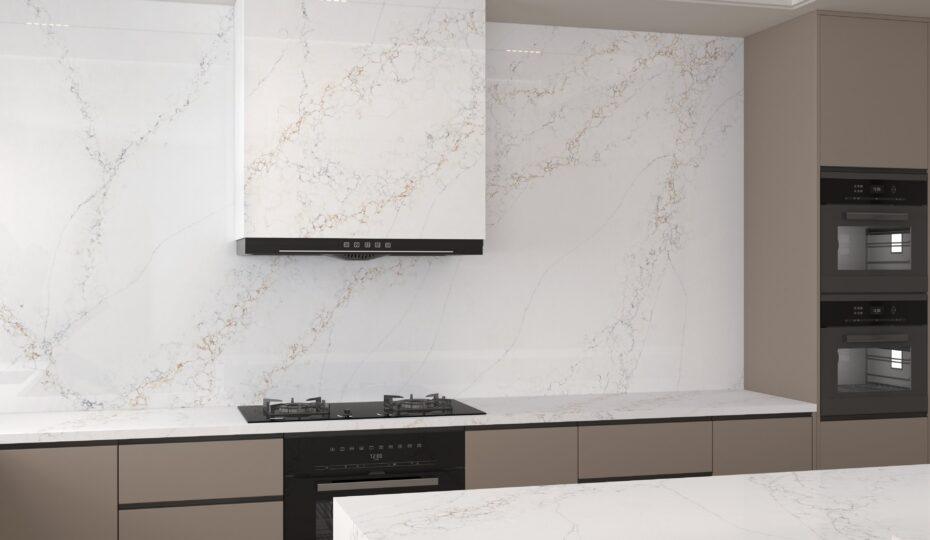
A fall home renovation works on a different clock than a summer project: the goal is usually to have the kitchen, fireplace, or guest bath finished before Thanksgiving, not sometime next spring. That timeline shapes material choices, and it is a big reason warm natural stone countertops and ultra-compact surfaces like Dekton dominate our showroom conversations from September through December. Below are five ways homeowners are using marble, quartzite, and Dekton to add warmth and depth before hosting season starts.
At Old Stone Tile and Marble Works, we fabricate and install on Long Island year-round, and autumn is consistently our busiest stretch for slab selection. Most kitchen projects run about three to five weeks from template to installation, so early October is roughly the cutoff for a comfortable pre-holiday finish.
1. Swap Cool Whites for Moody, Warm-Veined Marble and Quartzite
The stark white-and-gray quartz look that ruled the last decade is fading in favor of creams, honeyed beiges, earthy taupes, and stones with real gold or bronze movement. Think Calacatta Gold with its buttery ground and amber veining, Breccia and Crema marbles, or quartzites like Taj Mahal and Fantasy Brown that read soft and warm under evening light. The warm marble vs. quartzite trends we field most often come down to one honest tradeoff.
- Marble gives you the softest translucency and the most classic veining, but it is calcite-based, so it etches from acids (lemon, wine, vinegar) even when sealed.
- Quartzite is quartz-based and typically far harder, scoring around 7 on the Mohs scale versus roughly 3 to 4 for marble, so it resists scratching and etching much better.
- Price overlaps more than people expect: exotic quartzite often costs the same as or more than a mid-grade Calacatta.
This is where a showroom visit does something photos cannot. Slab color, vein density and depth shift dramatically under professional lighting, and no two blocks cut the same. We keep full slabs standing so you can see the whole piece, decide where the vein should land on your island, and tag the exact slabs reserved for your job.
2. Upgrade the Fireplace with Custom Dekton Cladding
From October on, the fireplace becomes the room’s focal point, and full-height slab surrounds have largely replaced tile and brick refacing in newer remodels. Running one continuous surface from hearth to ceiling removes grout lines entirely, which makes an 8-foot wall read taller and cleaner. Dekton fireplace cladding is the material we specify most for this application, and the reason is technical rather than stylistic.
Dekton is an ultra-compact surface sintered under high pressure and heat, with water absorption near zero and strong resistance to thermal shock, which is exactly what a working firebox surround demands. Cosentino, the manufacturer, rates it for both interior and exterior use, including facades that cycle through freeze and thaw.
Old Stone Tile and Marble Works is a certified installer of Dekton countertops on Long Island which matters for cladding more than for countertops. Practical details we handle on these jobs:
- Slab format: Dekton slabs run roughly 126 by 56 inches, so most standard surrounds are covered in one or two pieces with no visible seam at eye level.
- Thickness selection: 8mm and 12mm for vertical wall cladding to reduce weight, 20mm or 30mm for hearths and mantel caps that take load.
- Mitered edges: 45-degree miters at outside corners so the surface appears to wrap the wall as a solid block.
- Substrate prep: cement board and code-compliant clearances around the firebox opening, verified before templating.
3. Go Smooth with a Full-Height Backsplash
Subway tile is still fine, but the upgrade homeowners request for autumn entertaining is a continuous slab backsplash running from countertop to upper cabinets, or floor to ceiling behind a range. Book-matching two adjacent slabs so the veining mirrors across a centerline creates a symmetrical, almost wallpaper-like effect behind a hood, and it is one of the few details that reads custom from across the room.
Execution is entirely a fabrication problem. Our shop handles the vein continuation from horizontal counter to vertical splash, digital templating for out-of-square walls (common in older Long Island homes), and CNC cutouts for outlets, switches and pot fillers within tight tolerances. Edge profile work matters too: a 3cm eased or mitered edge on the counter with a matching 2cm splash keeps the whole composition consistent.
One planning note. Full-height splashes use significantly more material than a 4-inch backsplash, often adding 20 to 30 square feet to a mid-size kitchen, so slab yield gets calculated before you commit to a specific block.
4. Warm Up the Bathroom with Slab Walls and Stone Vanities
Cold-weather months make the primary bath the second most popular fall project after the kitchen. Instead of small-format tile, we are cladding shower walls and wet areas in large-format slabs, then carrying the same stone onto the vanity top and a waterfall side panel. Fewer joints means fewer grout lines to scrub and less water intrusion at corners.
- Shower walls: Dekton or porcelain slab for zero-maintenance performance in constant moisture.
- Vanity tops: quartzite or honed marble, where the daily abuse is lighter than a kitchen.
- Niches and curbs: cut from remnants of the same slab, which keeps color matched and reduces waste.
Honed finishes suit fall interiors better than high polish. A matte surface reads softer under warm 2700K lighting and hides water spots noticeably better than a gloss finish.
5. Get Ahead of Seasonal Spills: Fall Stone Care
Red wine, mulled cider, pumpkin puree and eight hours of holiday cooking put more stress on a countertop in one weekend than the previous two months combined. Your autumn kitchen remodel stone choices should account for how your household actually cooks, not just how the slab photographs.
For porous natural stone, sealing is the maintenance baseline. The Natural Stone Institute recommends testing absorbency by leaving a few drops of water on the surface for several minutes; if the stone darkens, it wants sealer. Practical guidance we give clients:
- Marble and lighter granite: reseal every 6 to 12 months in a working kitchen, more often around the sink and cooktop.
- Quartzite: usually 12 to 24 months, depending on density and finish.
- Dekton and engineered quartz: no sealing required, ever; near-zero porosity handles wine and oil without staining.
- Daily cleaning: pH-neutral cleaner only. Bleach, vinegar and citrus-based sprays dull polished marble surprisingly fast.
- Trivets: still worth using on engineered quartz, which contains resin and can scorch. Dekton and natural stone handle hot cookware far better.
If your family cooks daily with kids at the island, we will often steer you toward Dekton or quartzite for the perimeter and let a beautiful marble live somewhere lower-traffic, like a baking station or the bar.
Ready to Pick Your Slab Before Holiday Hosting?
Come see full slabs standing under showroom lighting at Old Stone Tile and Marble Works where our fabrication team can walk you through marble, quartzite and Dekton options for your kitchen, fireplace or bath. Contact us today to request a consultation to get your project templated in time for a pre-holiday install.