
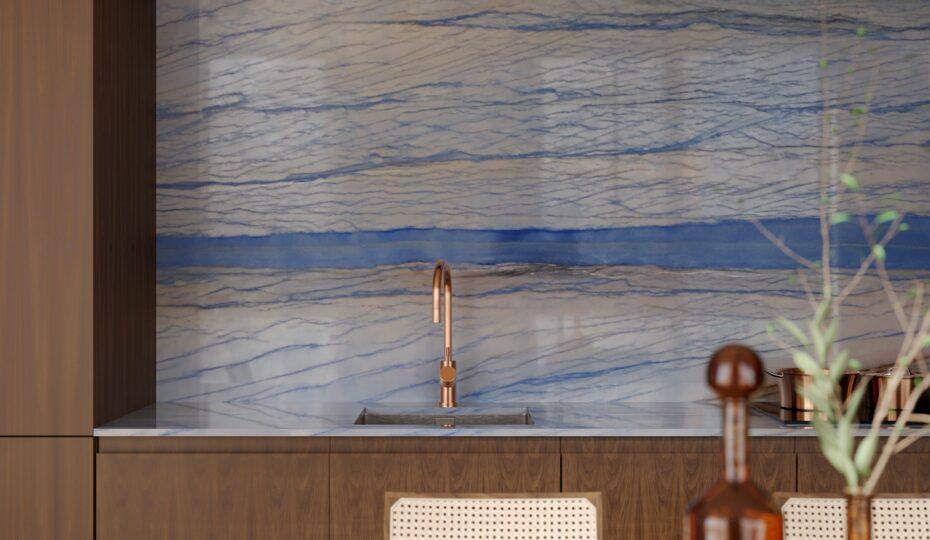
A backlit onyx bar front works because calcite crystals pass light through roughly three quarters of an inch of stone, turning veining that looks brown and muddy in daylight into amber, honey and rust. Quartzite behaves differently, and about half the slabs sold as translucent quartzite will barely glow at all. The difference between a feature wall that reads as jewelry and one that reads as a lit sign comes down to slab selection, LED spacing and how the frame is built behind the stone.
Why Onyx Glows and Most Quartzite Only Half Does
Onyx is a banded calcite formed in caves and hot springs, and its crystals grow in long, parallel columns that act almost like fiber optics. Light entering the back face travels along those columns and exits the polished front, which is why the banding appears to float rather than sit flat. That structure also makes onyx soft, around 3 on the Mohs scale, so it belongs on walls and vertical bar panels rather than working counters.
Quartzite is metamorphosed sandstone, and its translucency depends on how tightly the quartz grains fused and how much iron oxide or mica sits between them. White and pale gray quartzites such as Cristallo, Sea Pearl and some Patagonia lots transmit light well; darker, denser material with heavy mineral inclusions mostly blocks it. A good stone supplier on Long Island, NY will tell you which lots in the yard actually pass light instead of selling you on the name alone.
Reading a Slab on a Light Table Before You Buy
Never specify a translucent stone from a photo or a lit showroom sample. Ask the yard to stand the full slab against a light wall or roll a portable LED panel behind it, then walk the whole surface and look for these things:
- Dead zones: patches of heavy minerals that stay dark while everything around them lights up.
- Hairline fissures that are invisible dry but flare into bright white lines under light.
- Mesh shadow: a faint grid pattern from fiberglass backing, which shows clearly once lit.
- Resin pooling in fill areas, which reads as glossy yellow spots against the natural banding.
- Vein direction, so you can decide whether the pattern runs with the wall or fights it.
Photograph the lit slab with your phone from eight to ten feet back. The camera flattens contrast the same way the human eye does across a room, and defects that seemed minor at arm’s length often dominate the frame.
Thickness, Backing and the Fiberglass Problem
Standard 3cm slabs are usually too thick for a strong glow; light transmission drops sharply past about 20mm in most calcite onyx. For backlit installations, fabricators typically resaw or gauge the stone down to 2cm, and for small vanity backdrops or bar faces some shops go to 12mm bonded to low-iron glass or an aluminum honeycomb frame with a routed light window.
Almost all onyx arrives from the quarry with a fiberglass mesh and epoxy backing that keeps it from cracking in transit. That mesh will telegraph as a visible grid the moment you light it, so it has to be removed and the back honed flat, then the slab needs a structural substrate to replace the lost strength. This is where competent stone fabrication on Long Island, NY matters more than price per square foot: mesh removal, glass lamination and edge protection are shop skills, not field skills.
Picking LED Panels That Do Not Create Hot Spots
Individual LED strips or tape almost always produce striping through stone, because you can see each diode as a bright point behind a translucent surface. Edge-lit acrylic light panels, 10mm to 14mm thick with a laser-etched diffusion pattern, give the even wash that makes veining legible. Specify these characteristics:
- Color rendering of CRI 90 or higher, so the reds and ambers in the stone do not go gray.
- Color temperature of 2700K to 3000K for honey, amber and red onyx; 3500K to 4000K keeps white quartzite and blue veining from turning yellow.
- Dimming on a 0-10V or DALI driver, since most backlit walls look best at 30 to 60 percent output after dark.
- Panel joints are planned to fall behind opaque veining rather than clear bands, when a wall needs more than one panel.
The Illuminating Engineering Society publishes the measurement standards most reputable panel manufacturers cite, and any spec sheet that lists lumens without a CRI figure deserves a second look. Remote drivers, mounted in an accessible cabinet or adjacent closet, save you from opening a stone wall in year six when a driver fails.
Building the Frame: Air Gaps, Heat and Service Access
If the light panel presses directly against the back of the slab, every small imperfection in the stone becomes a bright artifact. Most fabricators hold a 1.5 to 3 inch air gap between the panel face and the stone, which softens the light and lets warm air move. Keep the stone surface under roughly 100°F, because sustained heat yellows epoxy fills and can pop a lamination over several years.
Aluminum extrusion frames with a welded or bolted grid work better than wood, which moves with humidity in coastal Nassau and Suffolk homes. Build at least one removable panel or a hinged section into the design, ideally at the base of a bar front or the side return of a fireplace surround, so drivers and panels can be replaced without cutting stone. Weep or vent slots at the top and bottom of the cavity, even a quarter inch, handle the heat load from a 40 to 80 watt panel.
Seams, Bookmatching and Epoxy That Disappears
Backlighting exposes seams brutally, since any gap in the stone becomes a lit line. Fabricators dry-lay bookmatched pairs in the shop, mark the seam, then color-match epoxy under the same light source that will be installed, not under shop fluorescents. Vein-matched butterfly layouts in onyx generally need slabs from sequential cuts in the same block, so reserve all the material at once.
Honed finishes scatter light slightly and hide small surface flaws, while polished finishes deepen color and reflect room light back at the viewer. For bar faces and vanity backdrops that get touched, a honed surface with a penetrating sealer holds up better against fingerprints and mild acids. The Natural Stone Institute maintains care guidance for calcite-based stone that is worth handing to the homeowner at closeout.
What Backlit Stone Costs on Long Island
Material for genuine translucent onyx typically runs $80 to $250 per square foot, with rare red and blue lots higher; translucent quartzite lands in the $70 to $180 range. Fabrication for a backlit assembly, including mesh removal, gauging, lamination and frame, commonly adds $60 to $150 per square foot, and the lighting package for a modest 30 square foot wall usually falls between $1,500 and $4,000.
A six foot bar front with a bookmatched pair, dimmed drivers and a serviceable frame often totals $9,000 to $18,000 installed. Costs climb with curved walls, mitered returns and any panel over about 60 inches wide, which may require a second light zone.
Frequently Asked Questions
How Thick Should Onyx Be for a Backlit Wall?
Most backlit onyx is finished at 20mm (2cm), and 12mm is common for small panels laminated to glass. Anything at 3cm transmits noticeably less light, and very dense lots at that thickness can look opaque even with a high-output panel behind them.
Can Quartzite Be Backlit Like Onyx?
Yes, but only pale, tightly crystallized lots, which is roughly half of what gets sold as translucent quartzite. Quartzite glows more diffusely than onyx, with less of the deep banded depth, and its hardness at 7 on the Mohs scale makes it the better pick where the panel may take abuse.
Will the LEDs Damage the Stone Over Time?
Quality LED panels running under 100°F at the stone face cause no measurable damage to the mineral itself over decades. The risk sits with epoxy fills and lamination adhesives, which can yellow under sustained heat, so air gaps and venting matter more than the diodes themselves. LED panels generally last 50,000 hours or more according to the U.S. Department of Energy.
How Do You Clean a Backlit Onyx Panel?
Use a pH-neutral stone cleaner and a soft cloth, never vinegar, glass cleaner or anything citrus-based, since onyx is calcite and etches in seconds. Reseal vertical panels every two to three years, or annually behind a wet bar.
Experience Your Vision with Precision
Whether you are selecting from our extensive in-stock inventory of marbles, granites, and quartz at our yard or exploring specialty onyx and quartzite through our exclusive local trade suppliers, our design team works directly with you to curate the ideal stone. Once you have tagged your exact slab at the supplier warehouse, it is delivered to our facility for expert resawing, mesh removal, lamination, and fabrication. For backlit installations, we work hand-in-hand with your general contractor by fabricating your finished stone strictly to your lighting layout and specifications before providing professional job-site delivery and installation. Contact Old Stone Tile and Marble today to schedule your design consultation and bring your vision to life.